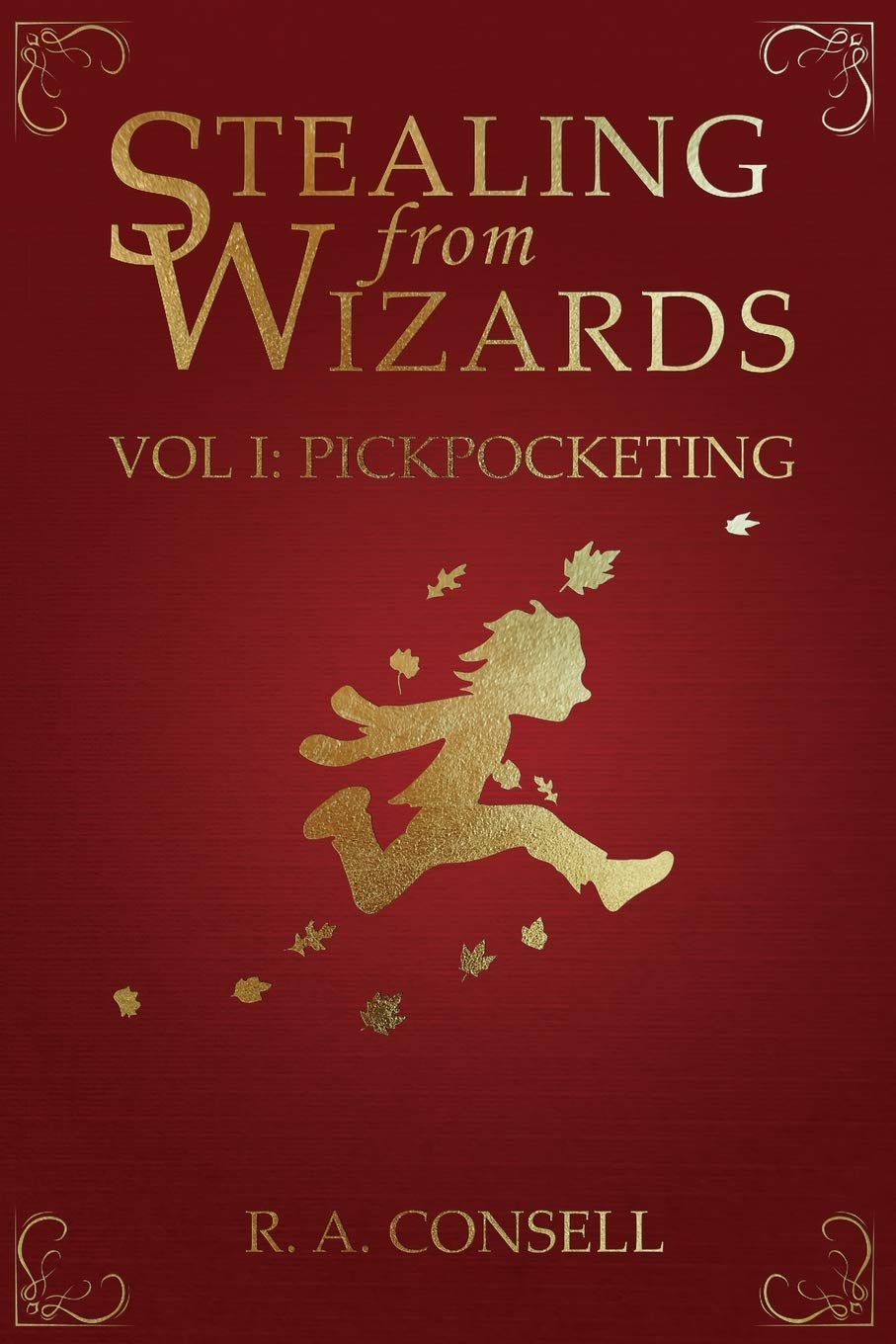
Good afternoon! You may or not be familiar with the Stealing From Wizards books by R. A. Consell, but if you are not I highly recommend it. It’s a very enjoyable magic student story written by a very humorous Canadian who I am proud to know. I recently sat down with Ryan to ask him some questions about his books and process.
The “Tax” of the World: How do you determine the “cost” or “tax” for your characters’ abilities or social status? Does using their power leave a physical or mental mark on their “character sheet”?
The cost for doing magic in Stealing from Wizards is all up front. As a series as much about school as it is about fantasy, the price for magic is the investment in learning it.
In this series, magic is both an innate ability and a skill, like musical talent. It’s something that people are born with some capacity for, and then training, study and practice refine that into something functional. So once a wizard has learned a spell, they can use it as much as they want just like a musician could play a song over and over.
The main thing preventing wizards from using dangerous and terrible magics all the time is that it takes a lot of study and specialist training to learn that kind of magic. Most wizards can’t hurl lightning bolts or fireballs around because they haven’t gone to the considerable effort to learn it. Those who do are often regarded with suspicion, because why would they need that kind of power?
Structural Geography: When you were mapping out your setting, did the environment (mountains, coastlines, city layouts) dictate the plot, or did you bend the landscape to fit the journey?
That was a thoroughly recursive process. Some geography sprang into existence due to a need arising from the story. Some story elements were inspired and informed by the setting. For some, that process went back and forth, round and round, throughout the series.
Take the fairy roads, for example. Those were inspired by fairy paths from Celtic folklore, then became a solution within the story to the problem of Canada being quite large and our protagonist needing to travel primarily on foot. Once part of the setting, they helped structure the borders of kingdoms, trade, culture, and mechanics of magic. Those all informed the plot, and provided tools to travel to other yet unimagined locations.
Something wonderful about writing fantasy is that circular process: inventing something, then asking what the implications of that would be on the story and the world.
Visual Subtext: You have a knack for atmospheric lighting and “set design.” If you were building a Pinterest board for this book’s “Special Collections” shelf, what’s the one visual that anchors the whole story?
There are a few setpieces that really frame the series — Detritus Lane, Bytown Market, The Granite Citadel, Avalon Island — but if I have to pick a single image to use as a reference, it’s the Avalon Academy school crest.
It’s a symbol created by and for the people within the narrative to represent the school. Like all such symbols, it represents the idealised version of the institution. It’s an exercise in myth making. In this case, the myth is that of unity. It represents four kingdoms coming together at one school, each represented by a symbol important to their culture. Also, like all such symbols, it is a lie. The unity is tenuous, the symbols an oversimplification, the motto boastful yet meaningless.
As I wrote the series, I often came back to this symbol to help remind me of the many mythologies I drew on to create the pastiche of folklore baked into Stealing from Wizards. It also evokes for me the divisions within the world, and the stories those divided cultures tell about themselves and each other.

Beyond the Prophecy: How do you ensure your teen protagonists have true agency and aren’t just “Chosen Ones” being pushed by the plot? What was a moment where a character surprised you by making a choice you hadn’t planned?
First, I don’t want to denigrate “chosen one” narratives. Those can be very fun and satisfying. Either for the simple pleasure of the fantasy of having a great destiny, or in exploring how someone might push back against one. Stealing from Wizards, though, is an exploration in the opposite direction. It’s about being the unchosen one, the misfit, the outcast, the leftover.
One way I avoid “protagonist syndrome” is to keep the story relatively small. These aren’t massive world-shattering events, their scale is such that the personal choices of one street thief arrested and sent to wizard school could have a meaningful impact. I also work to have other people in the background making their own choices and having their own lives happen. That keeps the world feeling deeper than we see. The story we’re reading is that of just one person; it isn’t the only story that’s happening in that world.
All that said, my characters often surprise me. I spend enough time with them that I think I can predict them, but they sometimes seem to have a will of their own. They’ll drag my plot sideways without permission. It’s quite rude, honestly.
One surprise I found was when and why our protagonist, Kuro, would stand his ground. He’s a thief, not a fighter. His response to almost any threat is to run and hide, or so I’d planned. What made him run towards danger rather than away was in defence of the defenceless. Even then, he wouldn’t fight, he’d just get in the way, preferring to take a bolt of lightning to the chest than allowing a feral cat to get injured. He spent a lot more time injured than I expected when I set out.
The “Human-First” Heart: In a market full of high-concept hooks, how do you keep the emotional resonance grounded? How do you verify your story’s “heart” is beating during the revision process?
The revision process is actually where the heart starts beating; there’s a lot of defibrillator action in the edits.
I find my first drafts tend to have a few too many beats, many of which are out of sync with each other. The greatest service my beta readers provide is to find those. They tell me what my books are about, what resonates with them and what leaves them cold.
Of course I think I know, but often I’m too close to it to peel apart the layers or to get emotionally invested like a first-time reader. Those rounds of edits trim the distractions and allow the heart to pump the story forward. If I do it well, it looks intentional and planned, not like the hacked up and stitched together Frankenstein’s monster it really is.
Inclusive Continuity: YA readers in 2026 value authenticity deeply. How do you handle the continuity of diverse lived experiences within your world-building to ensure it feels like a lived-in reality rather than “flavor text”?
Fantasy writing is always about finding a balance between the familiar and the strange. Yes, there’s magic and dragons, but at the core the stories are about people. In my case, they’re about students.
It’s cliche, but the advice to write what you know is sound. I’ve been a student my whole life, and educator of one kind or another for… this entire century. I’ve never thought of it that way before and I think I may need to go crumble to dust.
Anyway, that experience helps ground Stealing from Wizards in the familiar. I can draw on it to make believable students and teachers. With that grounding we can build in the strange: exploring the impact troublesome fairy folk would have on our academics, interrogating how unsupervised teen wizards would use their powers, having magical adventures with talking animals. Regardless of how strange it gets, the foundation of the story is always the characters, and those characters being anchored in familiar human experience keeps it feeling authentic.
The First Rehearsal: What was a specific “broken light” or “missing line” from your initial rehearsal of this book that you’re glad you fixed in the edit?
I’m having trouble thinking of one. Not because I’m some kind of literary genius that doesn’t have flaws in his work, but because there are so many that they all blur together. Sometimes they’re big. I cut two whole chapters from Pickpocketing, and added two after the second round of edits to Arson. Often they’re small. A comma can fundamentally change the nature of a sentence and by extension, the character saying it.
I think it’s fair to say that my first drafts have more broken lights than working ones. Learning to love the edits has been a major part of making my books work.
Doling out the Loot: How do you balance the “Information Reveal”? How do you resist the urge to info-dump and instead lead the reader slowly toward the “dragon’s hoard” of your backstory?
Broadly speaking, a book needs plot, character and setting. When I write, I want every sentence to be developing at least two of those. Ideally all three. We also want good prose; the words, themselves, should be enjoyable to read.
Keeping that in mind helps avoid spending too long delving into raw exposition. If lore needs to be shared, can that come from a character? If so, who? What does that tell us about that character? How would they share it? What would they include or leave out? What action can be going on while they do which could also advance the plot? Can we include a joke or some evocative metaphor to make the experience more engaging? I’m asking these questions continuously as I write.
The Lore Audit: At what point in your process do you “Poke the Holes”? Do you have a specific method for auditing your own internal logic, or do you rely on a “Story Guardian” (editor) to spot the issues?
I poke holes at every step in the process. I have a database of lore that I update and reference as I write. My alpha and beta readers are all clever humans who help me find gaps and inconsistencies. I find more that I and they missed in the edits. Then again during the audiobook recording.
I’m sure I still have some in the final drafts. I have some faithful readers who have reported to me via their fan theories explaining apparent contradictions. I celebrate their creativity, and then avoid admitting that what they found was a mistake.
That said, sometimes those gaps and inconsistencies are opportunities. They’re a hole which could spawn interesting stories later in the series. I also don’t think every hole needs to be plugged. So long as it isn’t undermining the core narrative, things can be a bit messy around the edges. Our world is, why should our fiction be different?
Amazon & Metadata: For authors starting today, what’s the one “Detect Magic” keyword strategy you wish you’d known when you first published on Amazon?
Ha! I wish I knew. There is no magic bullet, and to strain the metaphor a bit, the target is constantly moving. Anyone who tells you there is some secret way to get discovered is almost certainly selling a scam. And there are a lot of scams out there targeting indie authors. I get about one a day across every platform I’m on trying to offer “consultation services” or some such. Be very wary.
Lots of authors will offer advice on what has worked for them, but most of it comes down to getting lucky. My best advice is to give yourself lots of chances to get lucky. You’re never guaranteed to roll a natural twenty, but every roll is another chance. That might mean social media, paid advertising, book fairs, art, ARCs, or a million other things I haven’t thought of. I cleared out my inventory at one pre-Christmas book sale just by having sets of books pre-wrapped with a card attached. There’s no magic there, that’s just aunts and grandparents happy to not need to worry about packaging a gift.
The “Critical Success” Feeling: What does a successful launch look like to you now, compared to your first book? Is it about the sales numbers, or is it that one specific reader “page-turn” smile?
My idea of success changed a lot as books came out. I’m just some indie author from Canada. Statistically speaking, selling more books than I have immediate family members was worthy of celebration. Watching numbers climb and popularity grow as books came out was, I will not lie, gratifying.
However, it’s the satisfaction of “likes” on a facebook post. It’s addictive more than it is actually fulfilling. Also, if I tie my worth to those numbers, what happens when they stop climbing so quickly? Inevitable disappointment.
What I’ve found, over and over, that my “critical successes” have been the personal stories from readers. I have been incredibly fortunate to have people tell me about reading my books together as a family, talking about them over the dinner table, and listening together on car rides. I’ve had a mother thank me for writing the books that turned her son into a reader. I’ve been invited to do class visits for teachers who had read my books to their students. Those things are precious in ways I couldn’t have imagined when I started writing. That’s what will get me to write another book in a way gross sales numbers never could.
Thanks so much for your time, Ryan! If you’re a writer interested in building a lore database, or world bible, or other editing services, please check out my main website https://freelanceedits.com. And let me know if you’d like to see more interviews like this!
